
Patterns · 3 MIN READ
Fine Art Cross Stitch Patterns: Plan a Small Landscape
Choose suitable source art, compare crop and palette choices, and calculate the real workload before starting an art-inspired cross stitch.
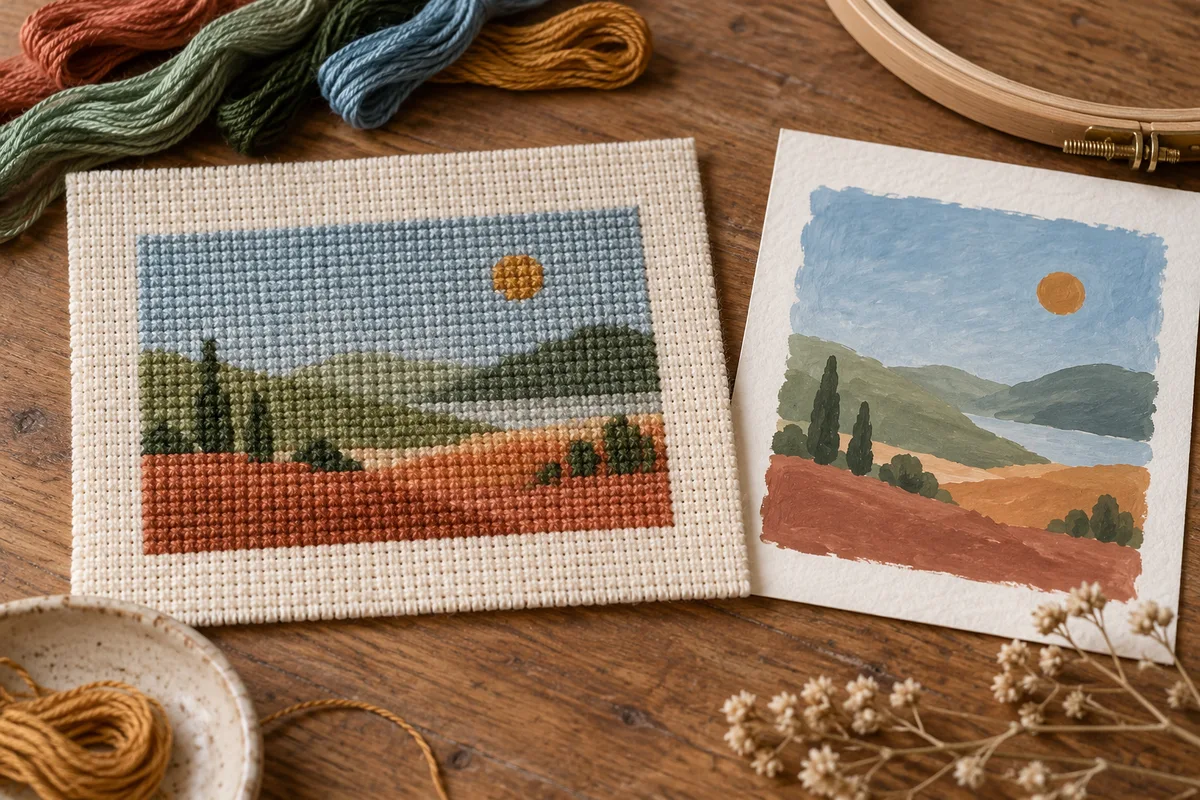
Begin with an image you may adapt
Fine art cross stitch patterns translate a picture into counted marks. Begin with your own painting or an image whose reuse terms allow your intended adaptation. A picture appearing on a search engine is not evidence of permission. Keep a record of the artwork, image source and applicable terms with your project.
The National Gallery of Art provides open-access images of eligible works on individual artwork pages. Check the specific object and its image status rather than assuming that every museum image has the same terms. This tutorial uses an invented landscape composition, not a reproduction of a named painting or a commercial chart.
Choose one focal point and a manageable crop
A distant figure, tiny signature or delicate brushstroke may vanish in a small grid. Look for a clear silhouette and large areas of distinguishable color. Crop around one focal point, such as a tree, a hill or a vase. Preserve the image proportions unless you deliberately redesign the composition.
For an original exercise, sketch three broad bands: sky, distant hills and foreground. Add a small sun and one darker hill edge. The goal is a readable arrangement with a handful of colors, rather than an automatic miniature of every brushstroke. Draw it in the grid designer or prepare a simple image for the photo maker.
Work out the physical size before converting
An 84 by 56 stitch landscape on 14-count Aida over one square measures 6 by 4 inches, or 15.24 by 10.16 cm. Its full rectangle contains 4,704 possible crosses. On 18-count Aida, the same chart measures about 4.67 by 3.11 inches. The chart has exactly the same detail and number of positions on either count.
Adding 2 inches of finishing allowance on every side to the 14-count example gives a 10 by 8 inch fabric cut before any additional allowance for your finishing method or shrinkage. That is an example, not a universal margin. Confirm the requirements of the actual frame and use the fabric calculator before cutting.
Let color groups carry the composition
Compare a limited palette with a slightly larger one at the same stitch width. In the simple landscape exercise, start with distinct sky, hill, foreground and accent colors. Keep adjacent areas different enough to separate in real thread. Adding similar shades everywhere can increase isolated stitches without clarifying the picture.
If the original art depends on subtle gradients, a small palette may not preserve its effect. You can increase grid dimensions, accept a stylized interpretation, or choose a simpler source. Thread colors selected on a monitor remain approximate. Compare physical skeins in suitable light before finalizing a color key.
Count the difficult areas, not just the rectangle
Full coverage of a 100 by 100 chart means 10,000 crosses; a 150 by 150 chart means 22,500. Increasing both dimensions by half more than doubles the area. A stitched-time estimate also depends on thread changes, counting and how often you need to start or end a color.
Inspect the symbol chart for single-stitch color changes near the focal point and in large background areas. Sample the most important 20 by 20 area on the intended fabric. This is a planning exercise, not a claim that any particular painting will convert successfully. Keep the final chart, key and source record together.
Prepare the piece for its intended finish
Leave sufficient unstitched fabric for mounting, avoid bulky thread carries across empty areas and follow the materials’ washing instructions. Do not cut the final edge until you know how it will be supported. Our framing guide explains mounting choices.
Can you sell an art-inspired finish? That depends on the source rights and any chart license. Permission to view an image is not permission to distribute a converted chart. For a fully original small landscape, keep your own draft and notes so its origin is clear.
Choose an original chart from our free collection, or check your fabric measurements before you begin.
Free cross stitch patterns · Fabric calculator